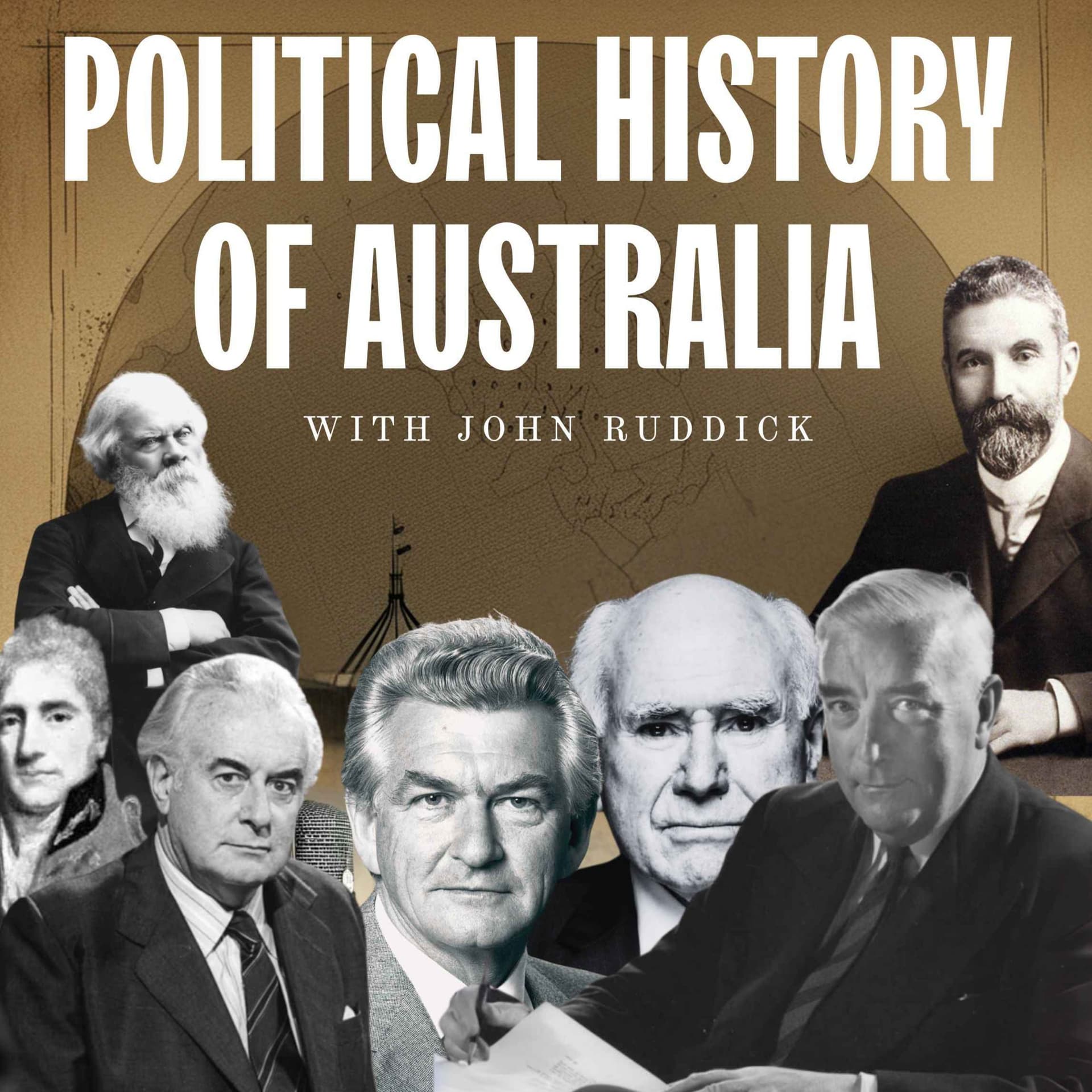
Political History of Australia
Welcome to the story of Australia. This podcast series by John Ruddick tells the political and geopolitical history of Australia, starting with the fabled "terra Australis" and then tracking the journey from British penal colony to a young federation, a country at war, and today one of the world’s great nations. Episodes released weekly. Hosted on Acast. See acast.com/privacy for more information.
Latest Episodes
E47: The Extraordinary Birth of Queensland
By the early 1820s, colonial administrators in Sydney were determined to establish a settlement in what we now know as Queensland. The essential in choosing a spot were a decent harbour and river. The Brisbane River was ideal but nature had hidden its mouth behind mangroves, sandbars and low islands. James Cook had sailed past it in 1770. Matthew Flinders had entered Moreton Bay in 1799, searched for a major river but left convinced none existed. Even John Oxley looked likely to miss it too unti…
E46: The Bathurst War
What You Need to Know About the Bathurst War (1822-1824) Relations between the settlers and the Aboriginals of the Bathurst region were remarkably good for a few years ... but then the arrival of 100,000 sheep and cattle changed that. Skirmishes began in 1822 and then escalated. By mid 1824 the newspapers in Sydney were referring to the violence as a war. Governor Thomas Brisbane declared martial law and sent in the troops. It became a conflict of vengeance but was its origin a dispute about lan…
E45: The Truth About Aboriginal Tribal Violence Pre-1788
This episode examines the nuance of Aboriginal life in Australian bush pre-1788. Life in the bush was often fun along with the usual ups and downs of life … but it was a warrior society driven largely by competition over scarce resources in the absence of individual property rights. Through the detailed first-hand testimony of William Buckley and others who lived for years among traditional groups, the episode describes the good times but also the cycles of revenge, disputes over women, and nigh…
E44: A Free Press Arrives in Australia
William Wentworth returned to Australia in 1824. He was a man on a mission – to overthrow the ruling clique in the colony who were hostile to even modest democratic reforms. Wentworth’s weapon of choice in this battle was a free press. ----------------------------------------------------------------------------------------------------- Please leave a comment, share and rate the show ⭐⭐⭐⭐⭐ Also listen and subscribe at Youtube and Rumble here 👉@politicalhistoryofaustralia The Hon. John Ruddick ML…
E43: Wentworth - Australia's Greatest Native Son
William Wentworth was described by Manning Clark as ‘Australia’s greatest native son.’ When Governor Macquarie departed Australia, his campaign to lift the social status of the emancipists was in tatters. All the institutions were lined up to defend the status quo. William Wentworth was a member of one of Britain’s most distinguished families. He was not a convict … but his mother was and his father, while not an emancipists, too often behaved like one. When it dawned on Wentworth that the curre…
E42: Australia's First Parliament
Last time the emancipists were on the back foot but then two hammer blows hit with Governor Macquarie’s departure. The new governor of NSW, Sir Thomas Brisbane, was a tough Major-General who had seen a lot of war. Governor Brisbane immediately sent an unmistakable message that he was a friend of the Exclusives. A few months later the findings of the Bigge Report hit Australia. Governor Brisbane was tasked with fundamentally reshaping Australia away from Macquarie’s egalitarian direction. But Big…
E41: Macquarie's Farewell: 'I Anticipate the Applause of Posterity.'
In this episode we say farewell to Governor Lachlan Macquarie after twelve years in Sydney. He championed the name Australia, made 26 January an official public anniversary, and was the first leading figure to address the colony as a people — “Fellow Citizens of Australia.” From first arrival to last days he backed emancipist rights, and that stance cost him the exclusives, the church, the courts and London. His last years were hard. In his farewell in Hyde Park he still said, “I anticipate the …
E40: The British Empire Strikes Back
Governor Lachlan Macquarie was on a sincere mission to lift up the former convicts known as emancipists. For years that project had gone his way — until the colonial establishment struck back and set out to put these “uppity” emancipists in their place. In this episode the church, the courts and then London itself flip from supporting the Governor to becoming his trenchant critics. Macquarie never wavers from his pro-emancipist stance, but under pressure he begins to act foolishly act in anger. …
E39: What Politicised the Emancipists?
In early New South Wales, more than four-fifths of the non-Aboriginal population were convicts, former convicts, or their children. Once free, these people — the emancipists — discovered that money and talent could not wash away the ex-convict stain. Wealthy exclusives still treated them as second-class subjects. This episode asks ‘what mobilised a scattered group of successful ex-prisoners into a political force?’ Governor Macquarie brought the best of them into the open. Architect Francis Gree…
E38: John Macarthur, Down and (Almost) Out in London
Episode 38 follows John Macarthur after he slipped out of New South Wales just before Lachlan Macquarie arrived to restore order. Having masterminded the Rum Rebellion, Macarthur exploited a legal loophole in Lord Castlereagh’s arrest orders and spent more than eight years in England. After the Rum Rebellion trial, Macarthur was stuck in England because if he returned to NSW he faced immediate arrest. So Macarthur waged a stubborn, years-long campaign against the Colonial Office to return home w…
E37: The Tale of Two Tasmanias
In September 1803 Lieutenant John Bowen raised the Union Jack at Risdon Cove on the Derwent, founding the first European settlement in Van Diemen’s Land. The next year, Governor King in Sydney, under orders from London, sent Lieutenant-Colonel William Paterson to command the proposed second settlement on the island at Port Dalrymple along the north coast. By late 1804 the island was formally divided at the 42nd parallel: the southern County of Buckinghamshire under Collins and the northern Count…
E36: The Van Diemen's Land Version of the First Fleet
In 1803, Governor Philip Gidley King in Sydney sent two ships to near modern day Hobart. There had been multiple earlier European visits to Van Diemen’s Land but these ships were going to stay and build a permanent British settlement. Governor King’s response was both reactive and decisive. By planting a permanent British presence on the Derwent — first through the small, improvised party under John Bowen and then through the far more substantial expedition led by David Collins — Britain convert…
E35: BONUS EPISODE - Address to 'The Women's Pioneer Society of Australasia'
Last week 'The Women's Pioneer Society of Australasia' invited me to speak about the Political History of Australia podcast. --------------------------------------------------------------------- Please leave a comment, share and rate the show ⭐⭐⭐⭐⭐ Also listen and subscribe at Youtube and Rumble here 👉@politicalhistoryofaustralia The Hon. John Ruddick MLC is a member of the NSW Legislative Council. johnruddick.com.au https://www.tiktok.com/@johnruddickmlc https://x.com/JohnRuddick2 https://www.…
E34: The Geopolitics of Pre-Colonial Van Diemen's Land
The people of what we now call Tasmania had lived in complete isolation since rising seas carved out Bass Strait around 10,000 BC, transforming their homeland from a southern peninsula of the Australian continent into the world’s most isolated island. European contact began in 1642 when Dutch explorer Abel Tasman claimed the land for the Netherlands. It was not until the 1770s, however, that a rapid succession of French and British visitors began to recognise its strategic value. When Bass and F…
E33: Australia's Neighbourhood in the Early 1820s
This episode we pause the story of Governor Lachlan Macquarie to take a panoramic tour of Australia’s near-abroad and Australia’s infant settlements in the early 1820s. With the Napoleonic Wars finally over and Britannia ruling the waves, London was able to focus more attention to its continental claim in the south. We survey the remarkably benign geopolitical setting in this corner of the globe and see how that freed up the colonists to focus on building a civilisation. We’ll travel clockwise a…
E32: Punching Through the Blue Mountains
In 1813 New South Wales was a fast-growing, optimistic society. The colony’s teenage growth spurt could no longer be contained by the rugged sandstone wall of the Blue Mountains just 50 kilometres west of Sydney. There were multiple valiant efforts to cross the Blue Mountains but it took the determination of Gregory Blaxland, backed by William Lawson and William Wentworth, to finally crack the code by staying on the high ridges instead of following the valleys. Macquarie quickly capitalised on t…
E31: Lachlan Macquarie Arrives with a Bang!
After the upheaval of the Rum Rebellion, London finally responds. In late December 1809, Lieutenant-Colonel Lachlan Macquarie arrives in Sydney Harbour. He moves quickly to be sworn in as governor on New Year’s Day 1810. Unlike his predecessors, Macquarie does not ease into power. He seizes it. From his first days in office Governor Macquarie moves with startling speed and authority. He orders the discredited New South Wales Corps home (though hundreds of soldiers choose to stay and become settl…
E30: London's Verdict on the Rum Rebellion
The men who led the march on Government House to depose Governor William Bligh in 1808 knew there would be consequences. Yet the Rebel Administration played a weak hand with skill and restraint. Beyond removing Bligh at gunpoint, they worked hard to appear measured and proper at every step. In this episode we examine London’s firm response to the Rum Rebellion: dispatching 800 battle-hardened troops from the 73rd Regiment, ordering a court martial, and recalling the New South Wales Corps. Lachla…
E29: The Rebel Administration
On the evening of 26 January 1808 the New South Wales Corps marched on Government House and did something extraordinary: they deposed Governor William Bligh at gunpoint. It remains the only successful armed overthrow of government in Australian history. What followed was one of the strangest and most revealing chapters in our early colonial story — the Rebel Administration. For nearly two years the colony was run by the very men who had arrested Bligh. John Macarthur effectively became the de fa…
E28: The Day of the Rum Rebellion
The label Rum Rebellion was a smear dreamed up decades after the seismic events of 26 January 1808. Those dramatic events were not about rum. It was fight over what the future of NSW should be. For some including Governor Bligh, NSW was to remain a large-scale open prison with a simply economy of small scale ex-convict farmers and an iron grip control by the state. But 20 years into the colony and too many residents could see that this land had too much potential to be limited by the other visio…